Which Scouring Pad Material Works Best with a Wood Pulp Sponge for Non-Stick Cookware
2026-08-10
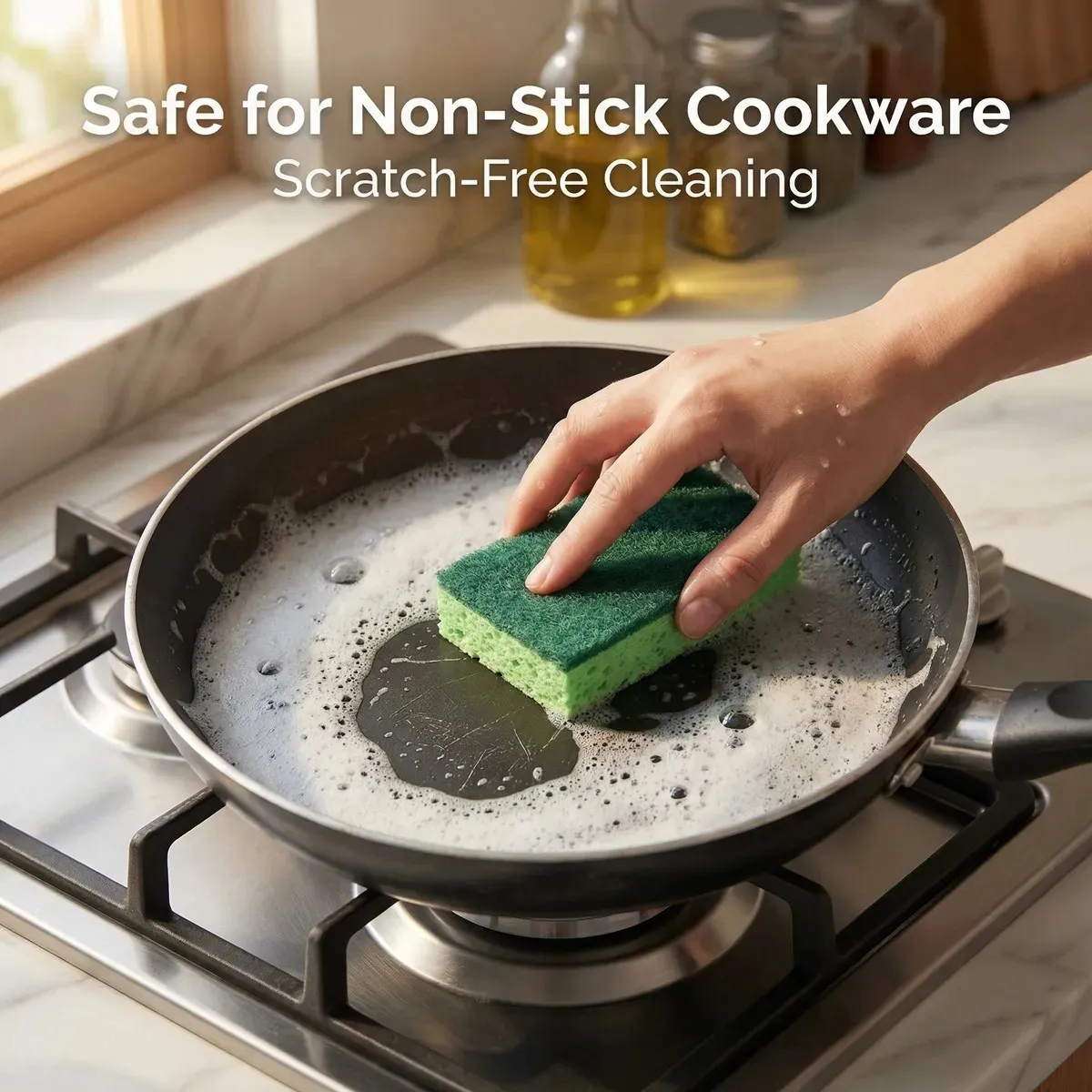
The best match for a wood pulp sponge used on non-stick cookware is usually a soft, non-scratch nonwoven pad with low abrasive loading. Fiber name alone does not decide safety. Nylon, polyester, and plant-fiber pads all vary with fiber thickness, grit, density, resin, and bonding. Your goal is to remove oil and cooked-on food without slowly dulling the coating.
Why Does Scouring Pad Material Matter for Non-Stick Cookware?
Non-stick cookware is easy to wash, but its coating is less forgiving than bare metal. Care guidance commonly calls for warm soapy water, a soft sponge, and no steel wool or rough abrasive pad. Your scrub layer needs controlled friction, not raw aggression.
The Coating Is the Working Surface
Fine scratches may not trigger an immediate complaint. Damage often appears later as poorer food release or a cloudy finish. A pad can pass a hand test and still fail after repeated cleaning.
This delayed failure matters to importers and private-label buyers. End users rarely blame their cleaning technique. They blame the sponge, the cookware, or both.
Contact Matters More than Hardness
Grease removal depends on detergent, contact area, flexibility, and motion. A stiff pad may skip curved corners, while a softer open-web pad follows the pan wall. Also check the cut edge. Rounded corners and a clean die-cut reduce concentrated pressure.
That edge detail sounds minor. In actual dishwashing, though, users often turn the sponge sideways to clean around rivets and pan rims. A rough edge may touch the coating before the flat pad does.
Which Scouring Pad Materials Should You Compare?
There is no universal “green pad” or “brown pad” standard. Color is mainly a visual code. You need the actual construction and a test result on representative cookware.
Low-Abrasive Nonwoven Polyester or Nylon
For broad compatibility, start with a soft nonwoven polyester or nylon pad with no metal wire and little or no coarse mineral abrasive. It offers even fiber distribution, stable wet thickness, and good flexibility.
Yet low abrasive matters. A nylon pad loaded with hard particles may still be too aggressive. Ask your supplier for:
• Abrasive type and loading
• Fiber thickness
• Pad basis weight
• Resin content
• Intended cleaning surfaces
• Wet flexibility
• Scratch-test method
Do not accept “non-scratch” as the complete specification. It is a performance claim, not a material name.
Soft Coconut or Other Plant-Fiber Pads
Coconut fiber supports a natural product story and can remove grease when strands are short, even, and firmly bonded. It is not automatically safe. Coarse strands, hard knots, or binder spots may create local pressure.
Run repeat-cycle tests before using a cookware-safe claim. No natural material gets a free pass just because the shelf story sounds good.
Plant-fiber pads may suit retailers that want a less synthetic appearance. They can also pair naturally with a cellulose sponge. Still, the whole composite must perform as one product. A soft wood pulp layer cannot compensate for an overly coarse scrub face.
Melamine, Emery, and Metal Scrubbers
Melamine foam cleans through fine physical abrasion. It suits many hard surfaces, but it is not the first choice for routine cleaning on a delicate pan interior.
Emery and metal scrubbers are more aggressive. They belong in separate heavy-duty ranges for rust, burnt deposits, grills, or uncoated metal surfaces. Clear warnings are needed.
Combining heavy-duty positioning with non-stick cookware positioning often leads to confused users, damaged pans, and return claims.
How Should a Wood Pulp Sponge Composite Be Built?
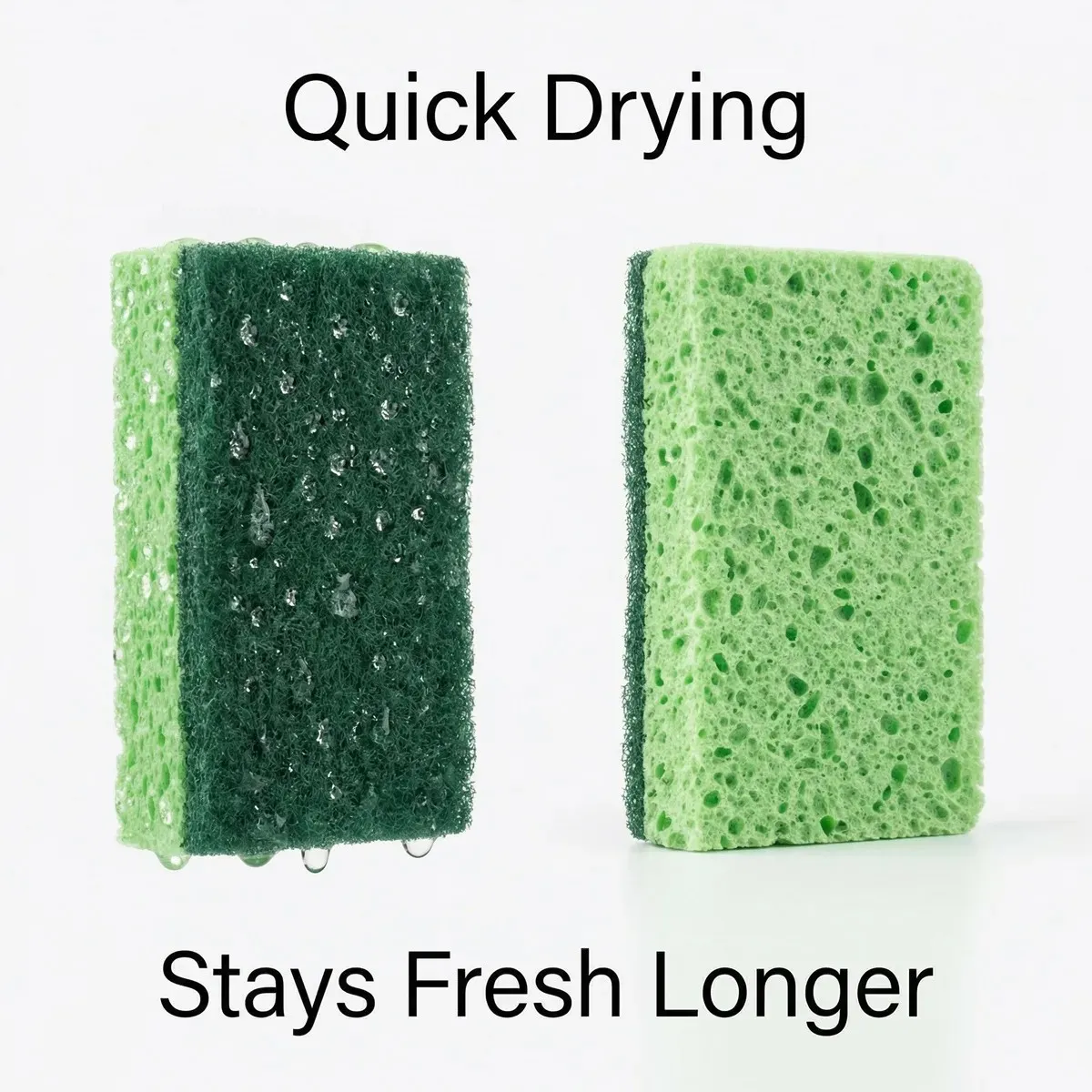
The scrub material is only one part. A good composite also needs the right absorbent face, support core, bond, edge finish, and thickness. The Wood Pulp Sponge and Scouring Pad Composite follows a three-layer concept with natural pulp, a high-elastic sponge core, and a scouring pad. Product data also lists customized color, logo, size, and packaging options.
Natural Pulp for Gentle Wiping
The wood pulp side handles daily washing, detergent spreading, and final rinsing. Cellulose absorbs water quickly and softens when wet. It becomes firm again after drying, which is normal rather than a defect.
For coated cookware, this should be the default working face. Simple pack instructions can tell users to reserve the scrub side for softened food residue.
A clear two-side instruction also reduces misuse. Without it, some customers assume the rough side is always the “main” cleaning side.
A Resilient Core for Better Pressure Control
The middle layer gives the sponge body. Too soft, and users press harder. Too firm, and it feels clumsy around rims. A balanced core spreads pressure and holds water and detergent.
Core recovery also matters. After squeezing, the sponge should return close to its original thickness. Poor recovery makes the product feel worn out long before the scrub layer has reached the end of its useful life.
A Flat Scrub Face with Strong Bonding
The pad should have no hard glue islands, raised corners, or exposed adhesive. Check bonding after hot-water soaking, detergent exposure, repeated squeezing, and several hundred wet strokes.
A non-scratch claim needs a repeatable test. A soft hand feel alone proves very little.
Loose edges create another problem. Once the pad begins to peel, users fold or grip the sponge differently. Pressure becomes uneven, and the lifted edge may collect food particles.
What Should B2B Buyers Test before Ordering?
A sample may look excellent on a desk and fail in a sink. Your approval method should copy real use and include more than one coating type.
Run a Repeat-Cycle Scratch Test
Test dark PTFE-style and ceramic surfaces with a fixed load, detergent dose, stroke length, and cycle count. Check at 50, 100, 300, and 500 strokes for:
• Visible scratches
• Surface haze
• Gloss change
• Color transfer
• Fiber shedding
• Weaker food release
A five-stroke demo is not product approval. Repeated contact is what separates a truly gentle pad from one that only feels soft when new.
Compare Grease Removal and Rinsability
Apply the same oil and food residue to each panel, dry it under fixed conditions, and count removal strokes. Then rinse the sponge.
A pad that traps dark particles may look unhygienic after one use, even when it still works. Poor rinsability can also lead to odor and more detergent consumption.
Do not test only with loose oil. Include dried starch, cooked protein, and a thin carbonized layer. Each soil type reacts differently to water, detergent, and friction.
Check Wet Strength and Layer Stability
Repeat soaking, squeezing, rinsing, and drying. Watch for swelling, curling, odor, cracking, and loose edges. The product data describes a reusable 10 × 8 × 3 cm format with custom sizes available. A dry cellulose sponge may feel hard when opened, so the label should say to wet it before use.
Also test the final retail pack. Compression may reduce carton volume, but excessive pressure can deform the bond line or leave a permanent curve in the scrub pad.
How Can You Match the Sponge to Your Sales Channel?
The same product should not carry the same message everywhere. Retail shoppers, restaurant buyers, and online sellers look for different proof.
Retail Packs Need Clear Instructions
Use simple wording such as “soft side for daily washing” and “scrub side for stuck food.” Avoid “safe for all surfaces” unless every listed surface has been tested.
Custom shapes may improve shelf recognition, but narrow points can tear sooner. Shape should support grip and durability, not just look cheerful.
Retail buyers may also ask for bright pad colors. Confirm that the color does not bleed into hot water or pale cookware.
Foodservice Buyers Need Repeatable Results
Commercial kitchens care about scrubbing time, rinse speed, odor, and replacement frequency. Provide a use guide by task.
The wood pulp side can be assigned to coated cookware and tableware. The scrub face can handle compatible utensils, sinks, or residue that has already been softened.
Color coding may separate cookware, counters, and washing areas. It is a modest feature, but it often makes staff training and reordering easier.
Private-Label Buyers Need Honest Claims
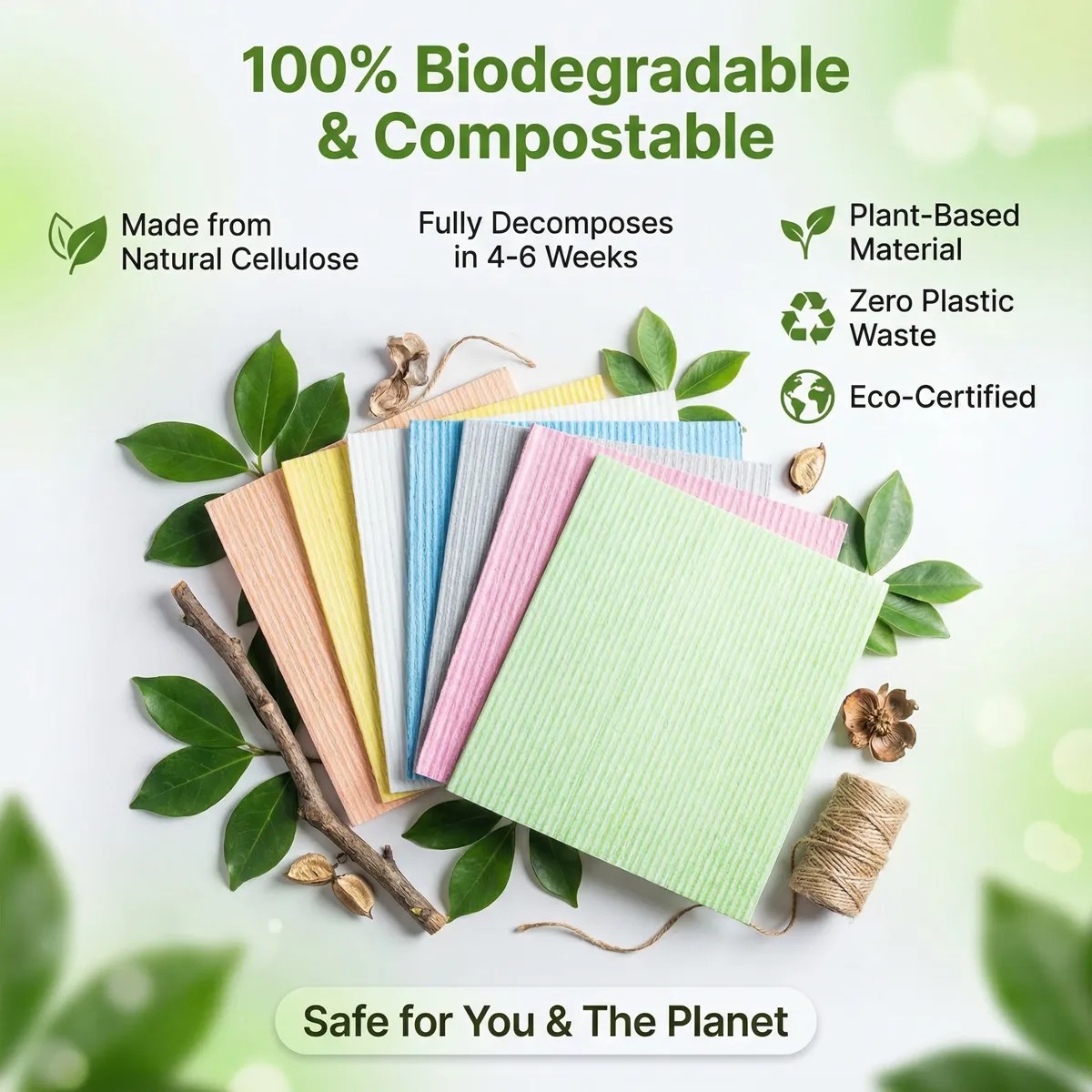
A composite may contain a biodegradable wood pulp face while its core, scrub pad, or adhesive is synthetic. Do not call the entire sponge plastic-free or fully compostable unless every component supports the claim.
FoamTech describes its wood pulp range as rapidly absorbent and offers custom die-cut shapes, branding, and packaging. Buyers should still confirm the bill of materials for the selected configuration before artwork approval.
Specific claims should match specific evidence. “Wood pulp cleaning side” is clearer than a broad environmental statement that cannot be verified across the entire product.
What Should You Expect from the Supplier?
Material selection works better when the supplier can adjust the full product, not only pad color. FoamTech develops cleaning sponges and supports private-label projects. Its company profile and knowledge materials describe product development, composite formats, and OEM packaging.
Product and Packaging Development
A practical custom service process should cover pad grade, sponge thickness, shape, logo, packaging material, artwork, and pre-production sample confirmation. This keeps the claim, product specification, and carton plan connected.
Packaging is not an afterthought here. A cellulose sponge changes feel as it dries, so instructions, pack ventilation, compression, and storage conditions all affect the customer’s first impression.
Samples Should Match the Final Specification
Request samples made with the planned fiber, abrasive loading, adhesive, thickness, and color. A generic stock sample cannot approve a custom composite.
Before the purchase order, agree on thickness tolerance, pad weight, bond strength, color range, pack dimensions, and scratch-test criteria. You can then contact the supplier with the cookware type, market, pack count, and required claims.
Conclusion
For non-stick cookware, a soft low-abrasive nonwoven polyester or nylon pad is usually the most practical partner for a wood pulp sponge. A well-processed plant-fiber pad can also fit an eco-focused range, but only after repeat-cycle testing.
Avoid choosing by color, fiber name, or a quick hand rub. The best composite balances gentle contact, grease removal, rinsability, drying, bond strength, and honest packaging claims. Controlled friction beats brute force.
FAQ
Q1: Can a Scouring Pad Be Non-Scratch and Still Remove Burnt Food?
A: Yes. A flexible low-abrasive pad can remove softened residue without coarse grit. Soaking the pan first and using detergent reduces the force required.
Q2: Is Coconut Fiber Safer than Nylon for Non-Stick Pans?
A: Not always. Soft coconut fiber may work well, while coarse strands may mark delicate coatings. Nylon also varies widely. Test the finished pad, not only the fiber name.
Q3: Why Does a Wood Pulp Sponge Become Hard When Dry?
A: Cellulose channels contract as moisture leaves. Wetting restores the soft, absorbent feel. This normal behavior should be stated on the pack.
Q4: Should the Whole Composite Be Marketed as Biodegradable?
A: Only when the pulp, core, pad, adhesive, ink, and other components meet the claim. Otherwise, describe the wood pulp layer accurately.
Q5: What Information Should You Send before Requesting a Sample?
A: Share the cookware coating, market, sponge dimensions, scrub level, color, logo, pack style, expected volume, and required tests. FoamTech can then prepare a more relevant proposal.
The best match for a wood pulp sponge used on non-stick cookware is usually a soft, non-scratch nonwoven pad with low abrasive loading. Fiber name alone does not decide safety. Nylon, polyester, and plant-fiber pads all vary with fiber thickness, grit, density, resin, and bonding. Your goal is to remove oil and cooked-on food without slowly dulling the coating.
Why Does Scouring Pad Material Matter for Non-Stick Cookware?
Non-stick cookware is easy to wash, but its coating is less forgiving than bare metal. Care guidance commonly calls for warm soapy water, a soft sponge, and no steel wool or rough abrasive pad. Your scrub layer needs controlled friction, not raw aggression.
The Coating Is the Working Surface
Fine scratches may not trigger an immediate complaint. Damage often appears later as poorer food release or a cloudy finish. A pad can pass a hand test and still fail after repeated cleaning.
This delayed failure matters to importers and private-label buyers. End users rarely blame their cleaning technique. They blame the sponge, the cookware, or both.
Contact Matters More than Hardness
Grease removal depends on detergent, contact area, flexibility, and motion. A stiff pad may skip curved corners, while a softer open-web pad follows the pan wall. Also check the cut edge. Rounded corners and a clean die-cut reduce concentrated pressure.
That edge detail sounds minor. In actual dishwashing, though, users often turn the sponge sideways to clean around rivets and pan rims. A rough edge may touch the coating before the flat pad does.
Which Scouring Pad Materials Should You Compare?
There is no universal “green pad” or “brown pad” standard. Color is mainly a visual code. You need the actual construction and a test result on representative cookware.
Low-Abrasive Nonwoven Polyester or Nylon
For broad compatibility, start with a soft nonwoven polyester or nylon pad with no metal wire and little or no coarse mineral abrasive. It offers even fiber distribution, stable wet thickness, and good flexibility.
Yet low abrasive matters. A nylon pad loaded with hard particles may still be too aggressive. Ask your supplier for:
• Abrasive type and loading
• Fiber thickness
• Pad basis weight
• Resin content
• Intended cleaning surfaces
• Wet flexibility
• Scratch-test method
Do not accept “non-scratch” as the complete specification. It is a performance claim, not a material name.
Soft Coconut or Other Plant-Fiber Pads
Coconut fiber supports a natural product story and can remove grease when strands are short, even, and firmly bonded. It is not automatically safe. Coarse strands, hard knots, or binder spots may create local pressure.
Run repeat-cycle tests before using a cookware-safe claim. No natural material gets a free pass just because the shelf story sounds good.
Plant-fiber pads may suit retailers that want a less synthetic appearance. They can also pair naturally with a cellulose sponge. Still, the whole composite must perform as one product. A soft wood pulp layer cannot compensate for an overly coarse scrub face.
Melamine, Emery, and Metal Scrubbers
Melamine foam cleans through fine physical abrasion. It suits many hard surfaces, but it is not the first choice for routine cleaning on a delicate pan interior.
Emery and metal scrubbers are more aggressive. They belong in separate heavy-duty ranges for rust, burnt deposits, grills, or uncoated metal surfaces. Clear warnings are needed.
Combining heavy-duty positioning with non-stick cookware positioning often leads to confused users, damaged pans, and return claims.
How Should a Wood Pulp Sponge Composite Be Built?
The scrub material is only one part. A good composite also needs the right absorbent face, support core, bond, edge finish, and thickness. The Wood Pulp Sponge and Scouring Pad Composite follows a three-layer concept with natural pulp, a high-elastic sponge core, and a scouring pad. Product data also lists customized color, logo, size, and packaging options.
Natural Pulp for Gentle Wiping
The wood pulp side handles daily washing, detergent spreading, and final rinsing. Cellulose absorbs water quickly and softens when wet. It becomes firm again after drying, which is normal rather than a defect.
For coated cookware, this should be the default working face. Simple pack instructions can tell users to reserve the scrub side for softened food residue.
A clear two-side instruction also reduces misuse. Without it, some customers assume the rough side is always the “main” cleaning side.
A Resilient Core for Better Pressure Control
The middle layer gives the sponge body. Too soft, and users press harder. Too firm, and it feels clumsy around rims. A balanced core spreads pressure and holds water and detergent.
Core recovery also matters. After squeezing, the sponge should return close to its original thickness. Poor recovery makes the product feel worn out long before the scrub layer has reached the end of its useful life.
A Flat Scrub Face with Strong Bonding
The pad should have no hard glue islands, raised corners, or exposed adhesive. Check bonding after hot-water soaking, detergent exposure, repeated squeezing, and several hundred wet strokes.
A non-scratch claim needs a repeatable test. A soft hand feel alone proves very little.
Loose edges create another problem. Once the pad begins to peel, users fold or grip the sponge differently. Pressure becomes uneven, and the lifted edge may collect food particles.
What Should B2B Buyers Test before Ordering?
A sample may look excellent on a desk and fail in a sink. Your approval method should copy real use and include more than one coating type.
Run a Repeat-Cycle Scratch Test
Test dark PTFE-style and ceramic surfaces with a fixed load, detergent dose, stroke length, and cycle count. Check at 50, 100, 300, and 500 strokes for:
• Visible scratches
• Surface haze
• Gloss change
• Color transfer
• Fiber shedding
• Weaker food release
A five-stroke demo is not product approval. Repeated contact is what separates a truly gentle pad from one that only feels soft when new.
Compare Grease Removal and Rinsability
Apply the same oil and food residue to each panel, dry it under fixed conditions, and count removal strokes. Then rinse the sponge.
A pad that traps dark particles may look unhygienic after one use, even when it still works. Poor rinsability can also lead to odor and more detergent consumption.
Do not test only with loose oil. Include dried starch, cooked protein, and a thin carbonized layer. Each soil type reacts differently to water, detergent, and friction.
Check Wet Strength and Layer Stability
Repeat soaking, squeezing, rinsing, and drying. Watch for swelling, curling, odor, cracking, and loose edges. The product data describes a reusable 10 × 8 × 3 cm format with custom sizes available. A dry cellulose sponge may feel hard when opened, so the label should say to wet it before use.
Also test the final retail pack. Compression may reduce carton volume, but excessive pressure can deform the bond line or leave a permanent curve in the scrub pad.
How Can You Match the Sponge to Your Sales Channel?
The same product should not carry the same message everywhere. Retail shoppers, restaurant buyers, and online sellers look for different proof.
Retail Packs Need Clear Instructions
Use simple wording such as “soft side for daily washing” and “scrub side for stuck food.” Avoid “safe for all surfaces” unless every listed surface has been tested.
Custom shapes may improve shelf recognition, but narrow points can tear sooner. Shape should support grip and durability, not just look cheerful.
Retail buyers may also ask for bright pad colors. Confirm that the color does not bleed into hot water or pale cookware.
Foodservice Buyers Need Repeatable Results
Commercial kitchens care about scrubbing time, rinse speed, odor, and replacement frequency. Provide a use guide by task.
The wood pulp side can be assigned to coated cookware and tableware. The scrub face can handle compatible utensils, sinks, or residue that has already been softened.
Color coding may separate cookware, counters, and washing areas. It is a modest feature, but it often makes staff training and reordering easier.
Private-Label Buyers Need Honest Claims
A composite may contain a biodegradable wood pulp face while its core, scrub pad, or adhesive is synthetic. Do not call the entire sponge plastic-free or fully compostable unless every component supports the claim.
FoamTech describes its wood pulp range as rapidly absorbent and offers custom die-cut shapes, branding, and packaging. Buyers should still confirm the bill of materials for the selected configuration before artwork approval.
Specific claims should match specific evidence. “Wood pulp cleaning side” is clearer than a broad environmental statement that cannot be verified across the entire product.
What Should You Expect from the Supplier?
Material selection works better when the supplier can adjust the full product, not only pad color. FoamTech develops cleaning sponges and supports private-label projects. Its company profile and knowledge materials describe product development, composite formats, and OEM packaging.
Product and Packaging Development
A practical custom service process should cover pad grade, sponge thickness, shape, logo, packaging material, artwork, and pre-production sample confirmation. This keeps the claim, product specification, and carton plan connected.
Packaging is not an afterthought here. A cellulose sponge changes feel as it dries, so instructions, pack ventilation, compression, and storage conditions all affect the customer’s first impression.
Samples Should Match the Final Specification
Request samples made with the planned fiber, abrasive loading, adhesive, thickness, and color. A generic stock sample cannot approve a custom composite.
Before the purchase order, agree on thickness tolerance, pad weight, bond strength, color range, pack dimensions, and scratch-test criteria. You can then contact the supplier with the cookware type, market, pack count, and required claims.
Conclusion
For non-stick cookware, a soft low-abrasive nonwoven polyester or nylon pad is usually the most practical partner for a wood pulp sponge. A well-processed plant-fiber pad can also fit an eco-focused range, but only after repeat-cycle testing.
Avoid choosing by color, fiber name, or a quick hand rub. The best composite balances gentle contact, grease removal, rinsability, drying, bond strength, and honest packaging claims. Controlled friction beats brute force.
FAQ
Q1: Can a Scouring Pad Be Non-Scratch and Still Remove Burnt Food?
A: Yes. A flexible low-abrasive pad can remove softened residue without coarse grit. Soaking the pan first and using detergent reduces the force required.
Q2: Is Coconut Fiber Safer than Nylon for Non-Stick Pans?
A: Not always. Soft coconut fiber may work well, while coarse strands may mark delicate coatings. Nylon also varies widely. Test the finished pad, not only the fiber name.
Q3: Why Does a Wood Pulp Sponge Become Hard When Dry?
A: Cellulose channels contract as moisture leaves. Wetting restores the soft, absorbent feel. This normal behavior should be stated on the pack.
Q4: Should the Whole Composite Be Marketed as Biodegradable?
A: Only when the pulp, core, pad, adhesive, ink, and other components meet the claim. Otherwise, describe the wood pulp layer accurately.
Q5: What Information Should You Send before Requesting a Sample?
A: Share the cookware coating, market, sponge dimensions, scrub level, color, logo, pack style, expected volume, and required tests. FoamTech can then prepare a more relevant proposal.
Prev: No data
Related Recommendations

Family owned company, globalleader in development andmanufacturing of home careproducts for private label andcontract manufacturing
Copyright © 2026 FoamTech (Zhejiang) New Materials Co., Ltd.